Missing teeth can affect more than your smile. They can change how you chew, how clearly you speak, how your bite feels, and how confident you feel in everyday situations. For many patients, Dental Implants are one of the most stable and natural-feeling options for replacing missing teeth.
At Q Smiles Dentistry in North Miami Beach, patients from Golden Glades, North Miami, Aventura, Sunny Isles Beach, Miami Gardens, and nearby Miami communities can explore implant options through a personalized dental evaluation. The right solution depends on your oral health, bone support, gum health, medical history, goals, and the dentist’s recommendation.
Dental implants are not the only way to replace missing teeth, and they are not automatically right for every patient. However, they are widely used because they can replace the root structure of a missing tooth and support a crown, bridge, or denture. The American Dental Association describes implants as posts surgically placed in the jaw where they act as anchors for replacement teeth.
Quick Answer
Dental implants are artificial tooth root replacements placed in the jaw to support a crown, bridge, or denture. They may help replace one missing tooth, several missing teeth, or a full arch of teeth, depending on the patient’s case.
For patients in North Miami Beach, Golden Glades, North Miami, Aventura, Sunny Isles Beach, Miami Gardens, and surrounding areas, Q Smiles Dentistry offers implant-related services including single dental implants, implant-supported dentures, All-on-X, tooth extractions, bone grafting, PRF therapy, and personalized treatment planning. The clinic’s own service page lists these implant and oral surgery services.
The best way to know if you are a candidate is to schedule an in-person exam. Your dentist will evaluate your gums, bone support, bite, medical history, and the number of teeth being replaced.
Table of Contents
What Are Dental Implants?
Dental implants are small posts, often made from biocompatible materials such as titanium, that are placed in the jawbone to support replacement teeth. They are designed to act like artificial tooth roots.
A complete implant restoration usually includes three main parts:
- Implant post: The part placed in the jawbone.
- Abutment: A connector between the implant and the visible restoration.
- Restoration: The crown, bridge, or denture that replaces the visible tooth or teeth.
For a single missing tooth, the implant may support one custom dental crown. For multiple missing teeth, implants may support a bridge or denture. For patients missing most or all teeth in an arch, solutions such as implant-supported dentures or All-on-X may be discussed.
The American Dental Association explains that dental implants are surgically placed in the upper or lower jaw and function as sturdy anchors for replacement teeth.
Why Dental Implants Feel Different From Removable Options
A traditional removable denture sits on top of the gums. A bridge is usually supported by nearby teeth. A dental implant is different because it is anchored in the jawbone.
This matters because the implant can provide a stable foundation for the replacement tooth. Stability can help with chewing comfort, speech, and confidence. It can also avoid placing extra preparation on neighboring teeth in cases where a single implant is appropriate.
That does not mean implants are always the right choice. Some patients may need periodontal treatment, bone grafting, extractions, or medical clearance before implant treatment can be considered.
Why Missing Teeth Should Not Be Ignored
A missing tooth can affect chewing, speech, tooth alignment, and bone support over time. Even if the gap is not visible when you smile, it may still affect your bite.
The ADA notes that missing teeth can affect how someone speaks or eats, and remaining teeth may shift. Bone loss can also occur around a missing tooth.
Common issues related to missing teeth may include:
- Difficulty chewing certain foods
- Extra pressure on remaining teeth
- Shifting of nearby teeth
- Changes in bite alignment
- Jawbone changes in the area of tooth loss
- Reduced confidence when speaking or smiling
- Denture looseness, depending on the case
If you live near North Miami Beach, Golden Glades, North Miami, Aventura, Sunny Isles Beach, or Miami Gardens and have one or more missing teeth, an evaluation can help you understand your options before the problem becomes more complex.
Who May Be a Candidate for Dental Implants?
A potential dental implant candidate usually needs healthy gums, enough jawbone support, good oral hygiene, and overall health that supports healing. The only way to know for sure is through an in-person dental exam.
Your dentist may evaluate:
- The number of missing teeth
- The health of your gums
- The amount and quality of jawbone
- Your bite and spacing
- Your medical history
- Medications that may affect healing
- Smoking or vaping habits
- Signs of infection, decay, or gum disease
- Whether extractions or bone grafting are needed
The ADA explains that general health can be more important than age when considering implants. It also notes that chronic illnesses and tobacco use may interfere with healing in some patients.
Cleveland Clinic also explains that certain factors, including active gum disease, severe bone loss, poor oral hygiene, smoking, vaping, and some medical conditions, may make implants less suitable or require additional planning.
Patients Who May Need Additional Treatment First
Some patients are not ready for implants immediately. That does not always mean implants are impossible. It may mean the dentist needs to address other issues first.
For example, a patient may need:
- Gum disease treatment
- Tooth extraction
- Bone grafting
- Sinus evaluation
- Deep cleaning
- Bite evaluation
- Medical clearance
- Improved oral hygiene before surgery
At Q Smiles Dentistry, implant planning is personalized. The goal is to understand the patient’s current oral condition and build a treatment plan that supports long-term function, comfort, and oral health.
Types of Dental Implant Solutions
Dental implants can replace one tooth, multiple teeth, or a full arch of teeth. The right option depends on how many teeth are missing, the condition of the remaining teeth, bone support, gum health, and the patient’s goals.
Q Smiles Dentistry’s implant and oral surgery services include single dental implants, implant-supported dentures, All-on-X, tooth extractions, bone grafting, PRF therapy, and personalized treatment planning.
Single Dental Implant
A single dental implant is often used to replace one missing tooth. The implant post supports one crown designed to fit the space and blend with the patient’s surrounding teeth.
This option may be considered when:
- One tooth is missing
- The nearby teeth are healthy
- The patient wants a fixed replacement
- There is enough bone to support an implant
- The dentist determines the area is suitable
A single implant may help avoid preparing neighboring teeth for a bridge, depending on the case.
Implant-Supported Bridge
An implant-supported bridge may replace several missing teeth in a row. Instead of using natural teeth as anchors, the bridge is supported by dental implants.
This option may be considered when:
- Multiple adjacent teeth are missing
- A removable denture is not preferred
- There is enough bone support
- The bite can be restored with a fixed solution
The number of implants needed depends on the treatment plan.
Implant-Supported Dentures
Implant-supported dentures attach to dental implants for improved stability compared with traditional removable dentures. Cleveland Clinic describes implant-supported dentures as dentures that attach to implants in the jaw, offering more stability than traditional dentures.
This option may be helpful for patients who struggle with loose dentures or want more confidence while eating and speaking.
All-on-X
All-on-X is a full-arch implant solution designed to support a full set of replacement teeth with a planned number of implants. The exact approach depends on the patient’s anatomy, bone support, bite, and dentist’s recommendation.
It may be discussed for patients who are missing most or all teeth in the upper or lower arch, or for patients whose remaining teeth cannot be predictably restored.
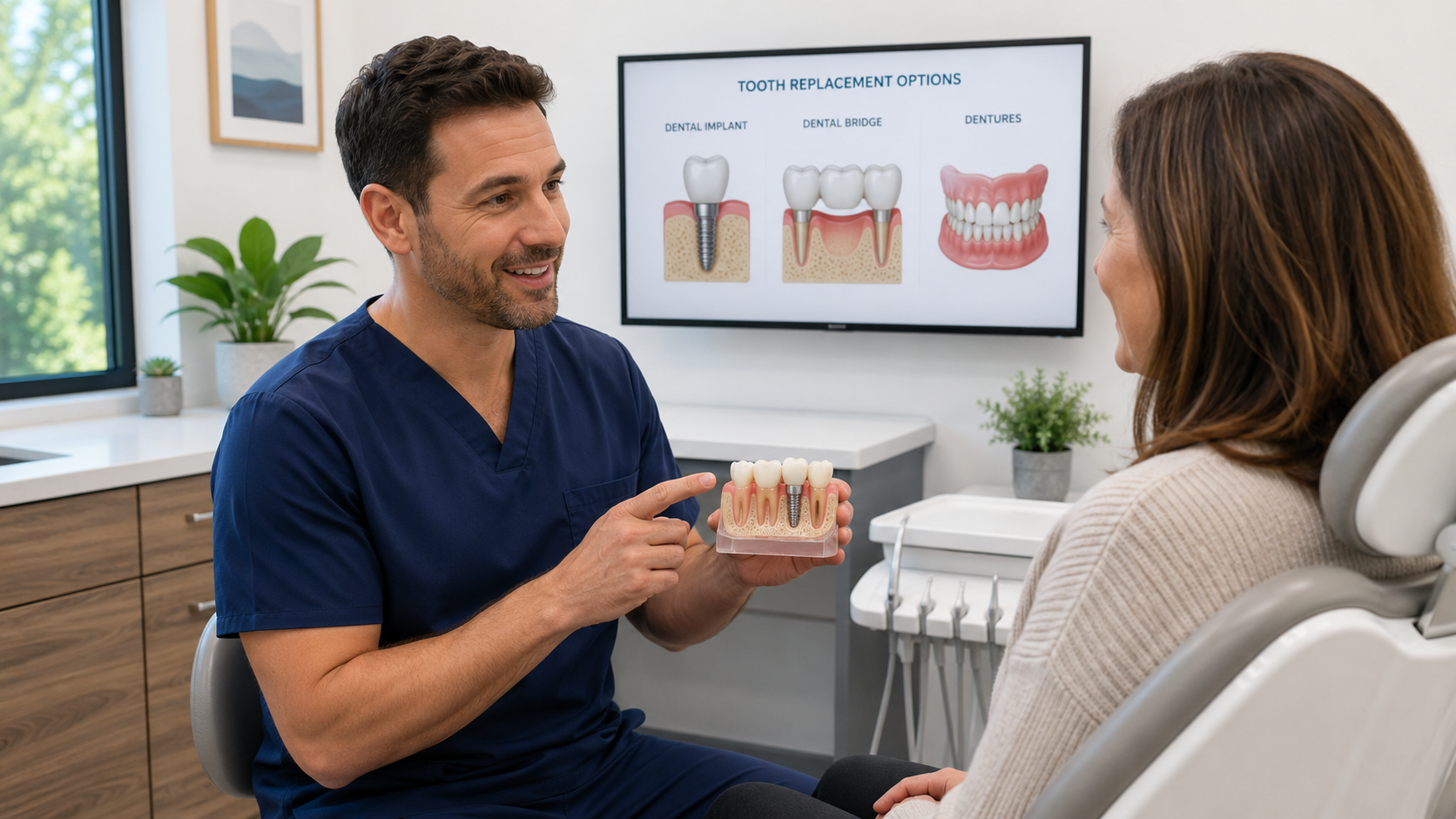
Dental Implants vs. Bridges vs. Dentures
Dental implants, bridges, and dentures can all replace missing teeth, but they work in different ways. The best choice depends on the patient’s oral health, goals, budget, timeline, and dental evaluation.
| Option | How It Works | Best For | Main Considerations |
|---|---|---|---|
| Dental implant | A post is placed in the jaw and supports a crown, bridge, or denture | One tooth, several teeth, or full-arch replacement | Requires surgery, healing time, and enough bone support |
| Dental bridge | A replacement tooth is supported by nearby teeth or implants | One or more missing teeth in a row | Traditional bridges may require reshaping nearby teeth |
| Removable denture | A removable appliance replaces multiple teeth | Several missing teeth or full-arch tooth loss | May feel less stable than implant-supported options |
| Implant-supported denture | Denture attaches to implants for added stability | Patients missing many or all teeth | Requires implant placement and treatment planning |
The ADA lists bridges, dentures, and implants as options for replacing missing teeth, while noting that implants are most similar to a natural tooth.
Why a Personalized Exam Matters
A comparison table can help you understand general differences, but it cannot replace an exam. Two patients may both be missing a molar, but one may have strong bone support and healthy gums while the other may need grafting or gum therapy first.
That is why Q Smiles Dentistry focuses on personalized treatment planning. The dentist can examine your teeth, gums, bite, and bone support before recommending a solution.

What to Expect During the Dental Implants Process
The dental implant process usually involves evaluation, planning, implant placement, healing, and final restoration. The timeline is personalized and can vary from patient to patient.
Cleveland Clinic explains that implant surgery is a personalized process and generally includes placing the implant, allowing time to heal, and attaching the post and final crown, bridge, or denture.
Step 1: Consultation and Exam
The first step is a dental consultation. The dentist reviews your concerns, examines your mouth, and discusses what you want to improve.
This visit may include:
- Oral exam
- Gum evaluation
- Bite evaluation
- X-rays or imaging
- Review of medical history
- Discussion of missing teeth
- Review of possible treatment options
For local patients in North Miami Beach and nearby areas, this appointment is the best starting point because it helps determine whether implants are realistic, whether another option may be better, or whether treatment is needed before implant placement.
Step 2: Personalized Treatment Plan
If implants may be suitable, your dentist will explain the recommended plan. This may include the number of implants, type of restoration, expected sequence of visits, healing time, and any related procedures.
Some patients may only need one implant and crown. Others may need extractions, bone grafting, or a full-arch plan.
Step 3: Implant Placement
During implant placement, the dental implant post is placed into the jawbone. Local anesthesia or other comfort options may be used depending on the case and clinical recommendation.
After placement, the gum tissue is closed and the healing phase begins.
Step 4: Healing and Osseointegration
Osseointegration is the process where the jawbone fuses around the implant. This is important because it helps create stability.
Cleveland Clinic states that osseointegration can take three to nine months in some cases, depending on how quickly the body heals.
Step 5: Abutment and Final Restoration
Once healing is complete, the dentist can attach the connector and final restoration. This may be a crown, bridge, or denture, depending on the treatment plan.
The final restoration is designed to restore function and appearance as much as possible for the patient’s situation.
Bone Grafting, PRF Therapy, and Jaw Support
Some patients need bone grafting before or during implant treatment because dental implants need adequate bone support. When a tooth has been missing for a long time, the jawbone in that area may change.
Bone grafting may help rebuild or support the area where an implant is planned. PRF therapy, or platelet-rich fibrin therapy, may also be used in some dental procedures to support healing. Whether these services are appropriate depends on the dentist’s evaluation.
Q Smiles Dentistry lists bone grafting and PRF therapy among its implant and oral surgery services.
Simple Definition: Bone Graft
A bone graft is a procedure that adds bone material to an area where more support is needed. In implant dentistry, it may be recommended if the jawbone is too thin, too soft, or too reduced to support an implant predictably.
Simple Definition: PRF Therapy
PRF stands for platelet-rich fibrin. It is made from a patient’s own blood and may be used in certain dental procedures as part of healing support. Not every patient needs it, and the dentist will explain whether it is relevant to the case.
How Long Do Dental Implants Take?
Dental implant treatment can take several months from start to finish, especially when healing or bone grafting is needed. Some cases are simpler, while others require more planning.
A general implant timeline may look like this:
| Phase | What Happens | Approximate Timing |
|---|---|---|
| Consultation | Exam, imaging, treatment discussion | First visit |
| Preparation | Extractions, gum treatment, or grafting if needed | Varies |
| Implant placement | Implant post placed in jawbone | One surgical visit |
| Healing | Bone fuses around implant | Often several months |
| Restoration | Crown, bridge, or denture is attached | After healing |
The ADA notes that some patients may need to wait several months until the implant is fully integrated, while other patients may be able to receive implants and replacement teeth in one visit, depending on the case.
This is why it is important not to compare your timeline to someone else’s. Your treatment plan should be based on your oral health, anatomy, and dentist’s recommendation.
Are Dental Implants Painful?

Patients should not feel pain during implant placement because the area is numbed, but some discomfort, swelling, or soreness after surgery can be normal. Your dentist will explain aftercare instructions based on your procedure.
Cleveland Clinic notes that providers use medication to numb the gums during the procedure and that slight discomfort and swelling after surgery can be normal.
After implant placement, your dentist may recommend:
- Soft foods for a period of time
- Avoiding chewing directly on the surgical site
- Keeping the area clean
- Taking medication as directed
- Avoiding smoking or vaping
- Attending follow-up visits
- Calling the office if unusual symptoms appear
You should contact your dentist if you notice symptoms such as worsening pain, swelling, fever, pus, a loose implant, or bleeding that does not seem normal.
Dental Implant Cost Considerations in South Florida
The cost of dental implants in South Florida can vary widely because every case is different. Q Smiles Dentistry does not list one universal implant price because the final cost depends on the patient’s exam, treatment plan, materials, complexity, oral health, and dentist recommendation.
Factors that may affect implant cost include:
- Number of missing teeth
- Number of implants needed
- Type of restoration
- Need for extraction
- Need for bone grafting
- Need for PRF therapy
- Gum health
- Bone quality and quantity
- Type of imaging needed
- Materials used
- Sedation or comfort options, if applicable
- Dental insurance benefits
- Financing options
In general industry discussions, dental implant treatment can range significantly based on complexity. A single implant with restoration may cost less than a full-arch implant solution, while cases that require grafting or multiple implants may involve higher total fees.
The most accurate way to understand cost is to schedule an evaluation. The office can review your case, explain the recommended plan, and help you understand available payment or financing options.
Q Smiles Dentistry states on its website that it offers flexible financing options through Cherry, U.S. Bank, and CareCredit.
How to Care for Dental Implants
Dental implants need daily oral hygiene and regular dental visits, just like natural teeth. While the implant itself cannot get a cavity, the gums and bone around it must stay healthy.
Good implant care may include:
- Brushing twice daily
- Flossing or using tools recommended by your dentist
- Cleaning around the implant carefully
- Attending regular dental checkups
- Avoiding tobacco use
- Wearing a nightguard if recommended
- Reporting looseness, bleeding, swelling, or discomfort
- Following all maintenance instructions
Cleveland Clinic notes that regular dental visits and proper hygiene are important for implant longevity.
What Can Cause Implant Problems?
Implant complications are not common in every case, but they are possible. Cleveland Clinic lists possible complications such as infection, delayed healing, nerve damage, sinus damage, and damage to nearby teeth.
Risk factors may include:
- Poor oral hygiene
- Smoking or vaping
- Untreated gum disease
- Certain medical conditions
- Poor bone support
- Excessive bite force
- Skipping dental maintenance
This is another reason why implant treatment should be planned carefully and maintained consistently.
Why Choose Q Smiles Dentistry in North Miami Beach?
Q Smiles Dentistry is located at 68 NE 167th St B, Miami, FL 33162, serving North Miami Beach, Golden Glades, North Miami, Aventura, Sunny Isles Beach, Miami Gardens, and nearby Miami communities. The clinic provides modern dental care in a warm environment and offers services that include dental implants, Invisalign, Botox, root canals, cosmetic smile makeovers, and routine dental care.
Q Smiles Dentistry’s website highlights:
- Friendly bilingual support in English and Spanish
- Comprehensive dental care in one place
- Modern dental technology
- Flexible financing options
- Dental implant and oral surgery services
- Family, cosmetic, restorative, and emergency dental care
The clinic also lists its phone number as (305) 947-6453 and its office address as 68 NE 167th St B, Miami, FL 33162.
Local Care Matters
Dental implant treatment often involves more than one visit. Choosing a local dental office near North Miami Beach can make the process easier, especially if you need follow-ups, adjustments, maintenance visits, or additional care.
Patients from nearby areas such as Golden Glades, North Miami, Aventura, Sunny Isles Beach, Miami Gardens, and surrounding Miami neighborhoods can schedule an evaluation to discuss whether implants are a good option for their situation.
When Should You Schedule an Implant Consultation?
You should consider scheduling a dental implant consultation if you are missing one or more teeth, have loose dentures, need an extraction, or want to understand your tooth replacement options.
Common reasons to schedule include:
- You lost a tooth recently
- You have an old missing tooth space
- You are tired of removable dentures
- You have a broken or severely damaged tooth
- You were told you may need an extraction
- You want a fixed tooth replacement option
- You want to compare implants, bridges, and dentures
- You want a local dental implant evaluation in North Miami Beach
An implant consultation does not force you into treatment. It simply gives you clarity. You can ask questions, review options, and understand the next steps based on your oral health.
CTA: Schedule Your Dental Implant Evaluation
If you are researching Dental Implants in North Miami Beach, Q Smiles Dentistry can help you understand your options with a personalized evaluation.
Call +1 305-947-6453 or visit Q Smiles Dentistry at 68 NE 167th St B, Miami, FL 33162.
FAQs About Dental Implants
1. Are Dental Implants a permanent solution for missing teeth?
Dental implants are designed as a long-term tooth replacement option. With proper care, regular dental visits, and healthy gums, they can last many years. However, no dental treatment should be described as guaranteed for every patient. Longevity depends on oral hygiene, bite forces, health conditions, smoking habits, maintenance, and the dentist’s recommendations.
2. How do I know if I am a candidate for Dental Implants?
The only way to know is to schedule an in-person dental evaluation. Your dentist will check your gums, bone support, bite, medical history, and the area where the tooth is missing. Some patients are ready for implants, while others may need gum treatment, extraction, bone grafting, or other steps first.
3. Can Dental Implants replace multiple missing teeth?
Yes, dental implants may be used to replace one tooth, several teeth, or a full arch of teeth. Depending on your case, the dentist may discuss a single implant, implant-supported bridge, implant-supported denture, or All-on-X solution.
4. How long does the Dental Implants process take?
The timeline varies. Some patients need several months because the implant must heal and integrate with the jawbone. If bone grafting, extractions, or gum treatment are needed, the total timeline may be longer. Your dentist can give you a more accurate estimate after an exam.
5. Are Dental Implants better than dentures?
Dental implants and dentures solve different needs. Implants are fixed or implant-supported, while traditional dentures are removable. Implants may provide more stability, but they require surgery, healing time, and adequate bone support. Dentures may be better for some patients depending on health, budget, timeline, and treatment goals.
6. Do Dental Implants hurt?
During the procedure, the area is numbed, so patients should not feel pain during implant placement. Some soreness, swelling, or discomfort afterward can be normal. Your dentist will provide aftercare instructions and explain what symptoms should be reported.
7. How much do Dental Implants cost in North Miami Beach?
The cost varies based on the number of implants, type of restoration, materials, imaging, extractions, bone grafting, gum health, and case complexity. Q Smiles Dentistry does not provide one universal price because every patient needs a personalized exam and treatment plan.
8. Where can I get Dental Implants near Golden Glades or North Miami?
Q Smiles Dentistry is located in North Miami Beach at 68 NE 167th St B, Miami, FL 33162. The clinic serves patients from Golden Glades, North Miami, Aventura, Sunny Isles Beach, Miami Gardens, and nearby Miami communities.
Conclusion: Take the First Step Toward Replacing Missing Teeth
Dental Implants can be a strong option for replacing missing teeth, restoring chewing function, and supporting a more confident smile. They are not the right choice for every patient, and the best treatment depends on your oral health, bone support, gum health, medical history, and personal goals.
If you live in North Miami Beach, Golden Glades, North Miami, Aventura, Sunny Isles Beach, Miami Gardens, or a nearby Miami community, Q Smiles Dentistry can help you explore your options with a personalized evaluation.
Call +1 305-947-6453 or visit Q Smiles Dentistry, 68 NE 167th St B, Miami, FL 33162 to schedule your consultation.
Sources
- American Dental Association, MouthHealthy: “Implants”
https://www.mouthhealthy.org/all-topics-a-z/implants - American Dental Association, MouthHealthy: “Missing Teeth”
https://www.mouthhealthy.org/all-topics-a-z/missing-teeth - Cleveland Clinic: “Dental Implants: Surgery, Purpose & Benefits”
https://my.clevelandclinic.org/health/treatments/10903-dental-implants - Cleveland Clinic: “Implant Supported Dentures: Process, Benefits & Care”
https://my.clevelandclinic.org/health/treatments/24303-implant-supported-dentures