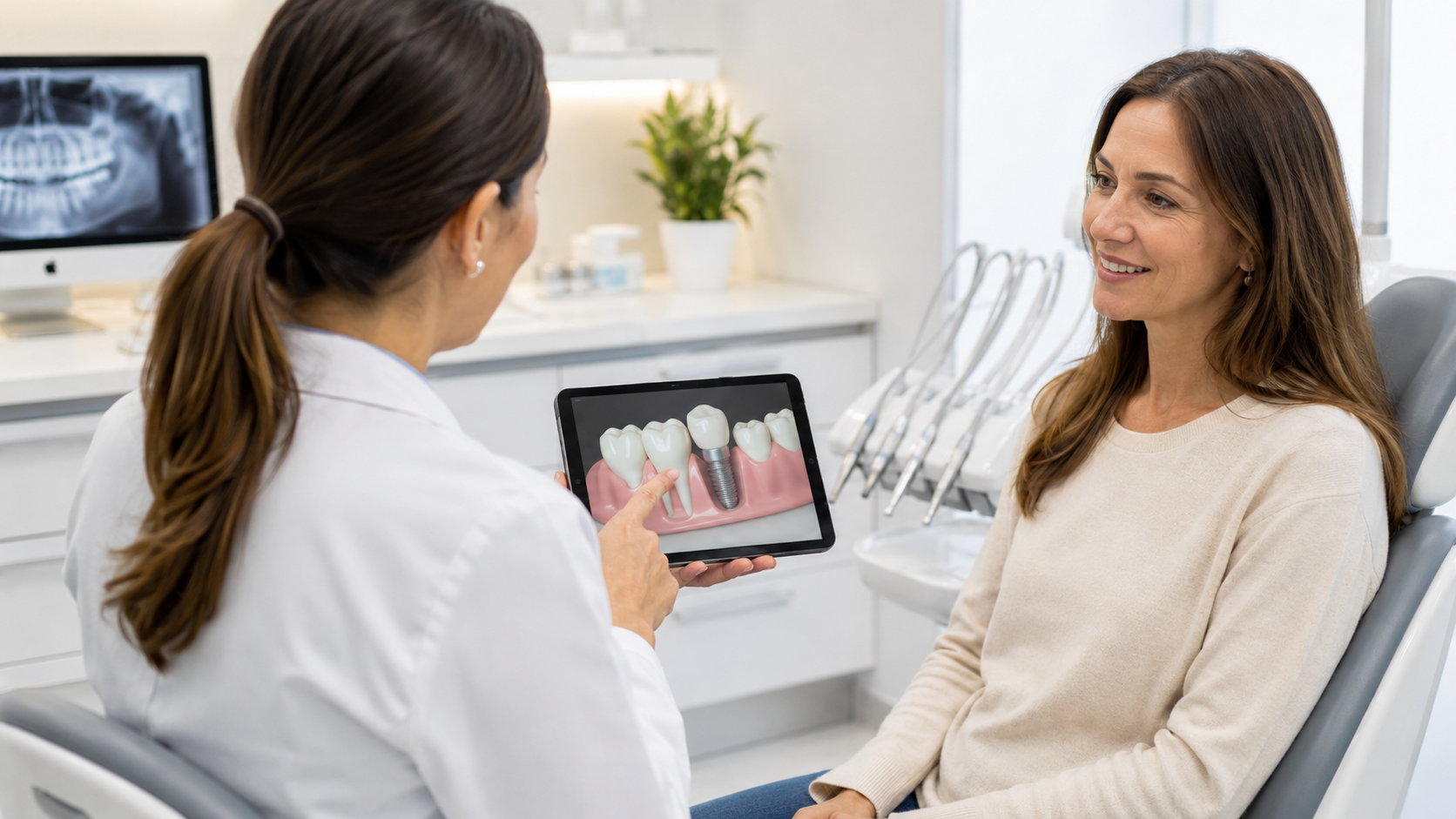
If you are missing one tooth, several teeth, or most of your teeth, choosing the right Tooth Replacement option can feel overwhelming. Dental implants, bridges, and dentures can all help replace missing teeth, but they work in different ways, require different levels of care, and may fit different patient needs.
At Q Smiles Dentistry in North Miami Beach, patients from Golden Glades, North Miami, Aventura, Sunny Isles Beach, Miami Gardens, and nearby Miami communities can schedule an in-person evaluation to compare their options. The best choice depends on your oral health, bone support, gum health, bite, budget, treatment goals, and the dentist’s recommendation.
A dental implant is a surgical tooth replacement option that supports a crown, bridge, or denture. A dental bridge replaces one or more missing teeth by connecting an artificial tooth to nearby teeth or implants. A denture is a removable appliance that can replace several teeth or a full arch. Cleveland Clinic describes dental implants as a common surgical option that supports artificial teeth such as crowns, bridges, and dentures. The American Dental Association also explains that dentures are removable appliances that can replace missing teeth and help restore a smile.
Q Smiles Dentistry in North Miami Beach helps patients compare tooth replacement options with personalized dental care in a modern, welcoming setting.
Quick Answer
The best tooth replacement option depends on your oral health, how many teeth are missing, your jawbone support, your comfort with surgery, your budget, and your long-term goals. Dental implants are often chosen for stability and bone support, bridges can be useful for replacing one or a few teeth without removable appliances, and dentures can replace multiple teeth or a full arch with a removable solution.
There is no single option that is best for every patient. A person missing one tooth may be a good candidate for an implant or bridge. A person missing several teeth may need a partial denture, implant-supported bridge, or implant-supported denture. A person missing a full arch may compare traditional dentures with implant-supported options.
Q Smiles Dentistry provides dental implant and oral surgery services, including single dental implants, implant-supported dentures, All-on-X, tooth extractions, bone grafting, and PRF therapy. The office is located at 68 NE 167th St B, Miami, FL 33162 and lists its phone number as (305) 947-6453.
To compare tooth replacement options for your specific case, schedule an appointment with Q Smiles Dentistry.
Table of Contents
Why Tooth Replacement Matters
Tooth replacement matters because missing teeth can affect chewing, speech, appearance, bite balance, and long-term oral health. Even one missing tooth can change how the surrounding teeth function.
When a tooth is lost, nearby teeth may gradually shift into the open space. The opposing tooth may also move because it no longer has a matching tooth to bite against. Over time, this can affect the bite and make future treatment more complicated.
The American Dental Association notes that missing teeth can affect speaking and eating, and remaining teeth may shift. It also explains that bone loss can occur around missing teeth.
Common reasons patients explore tooth replacement include:
- A missing front tooth
- A missing molar
- Multiple missing teeth
- Loose or uncomfortable dentures
- A tooth that may need extraction
- A broken tooth that cannot be restored
- Difficulty chewing
- A visible gap when smiling
- Concern about shifting teeth
Tooth replacement is not only cosmetic. It can be part of restoring function, protecting the bite, and supporting better long-term dental health.
Simple Definition: Tooth Replacement
Tooth replacement is any dental treatment designed to replace one or more missing teeth. Common options include dental implants, bridges, partial dentures, complete dentures, implant-supported dentures, and full-arch implant solutions.
If you are missing teeth near Golden Glades, North Miami, Aventura, Sunny Isles Beach, Miami Gardens, or surrounding Miami communities, a local dental evaluation can help you compare realistic options.
What Are Dental Implants?
Dental implants are artificial tooth roots placed in the jawbone to support replacement teeth such as crowns, bridges, or dentures. They are often used to replace one tooth, several teeth, or a full arch of teeth.
A dental implant restoration commonly includes:
- The implant post placed in the jawbone
- An abutment that connects the implant to the restoration
- A crown, bridge, or denture that replaces the visible tooth or teeth
According to Cleveland Clinic, dental implants provide support for artificial teeth like crowns, bridges, and dentures, and the process may require several procedures and months of healing.
Main Benefits of Dental Implants
Dental implants may offer several advantages for the right patient:
- They can feel stable once healed
- They do not rely on removable adhesive
- They can support a single crown, bridge, or denture
- They may help reduce bone loss after tooth loss
- They do not require reshaping healthy neighboring teeth in many single-tooth cases
- They can support full-arch solutions when appropriate
Cleveland Clinic states that implants can help prevent bone loss after tooth loss or removal, and they do not require healthy teeth to be removed or changed for placement.
Main Considerations With Dental Implants
Dental implants are not right for every patient. They require a dental evaluation, surgery, healing time, and adequate bone support.
Possible considerations include:
- They require oral surgery
- Healing may take several months
- Bone grafting may be needed
- Gum disease may need treatment first
- Medical history may affect candidacy
- Smoking or vaping may affect healing
- Cost may be higher than some other options
- Insurance coverage can vary
The right plan depends on an in-person exam. Your dentist needs to evaluate the missing tooth area, gums, jawbone, bite, and overall oral health before recommending an implant.
Who May Be a Good Candidate for Dental Implants?
A potential implant candidate often has healthy gums, adequate jawbone support, and good overall health for healing. Some patients may need additional treatment first, such as extractions, periodontal care, or bone grafting.
At Q Smiles Dentistry, dental implants and oral surgery services include single dental implants, implant-supported dentures, All-on-X, extractions, bone grafting, and PRF therapy.
What Is a Dental Bridge?
A dental bridge is a fixed restoration that replaces one or more missing teeth by bridging the gap with an artificial tooth. Traditional bridges are usually supported by crowns placed on the teeth next to the missing space.
Cleveland Clinic explains that a dental bridge consists of crowns that fit over natural teeth on either side of the space and artificial teeth that fill the gap.
A bridge may be considered when:
- One tooth is missing
- A few teeth in a row are missing
- The neighboring teeth need crowns anyway
- The patient wants a fixed option
- The patient is not a good implant candidate
- The patient wants to avoid implant surgery
- The dentist determines the support teeth are suitable
Main Benefits of a Dental Bridge
A dental bridge can be a practical tooth replacement option in the right case.
Possible benefits include:
- It is fixed, not removable
- It can restore chewing in the missing tooth area
- It may be completed faster than implant treatment in some cases
- It may be suitable when implants are not recommended
- It can restore the appearance of a missing tooth
- It can prevent nearby teeth from drifting into the open space
Main Considerations With a Dental Bridge
Traditional bridges usually require reshaping the nearby teeth so crowns can fit over them. This may be a good choice if those teeth already need crowns, but it may not be ideal if the neighboring teeth are completely healthy.
Bridge considerations may include:
- The supporting teeth must be strong enough
- Cleaning under the bridge requires special care
- Decay or gum problems can affect the supporting teeth
- A bridge does not replace the tooth root
- It may need replacement over time
- It may not be ideal for long spans of missing teeth
A bridge can be a good solution for some patients, but it should be compared carefully with implant and denture options.
What Are Dentures?
Dentures are removable appliances that replace missing teeth and surrounding tissues. A partial denture replaces some missing teeth, while a complete denture replaces a full arch of missing teeth.
The ADA describes dentures as removable appliances that can replace missing teeth and help restore your smile.
Types of Dentures
There are several denture options, including:
- Partial dentures: Replace some missing teeth when some natural teeth remain.
- Complete dentures: Replace all teeth in the upper or lower arch.
- Immediate dentures: Placed soon after extractions in certain cases.
- Implant-supported dentures: Attach to dental implants for added stability.
- Overdentures: Fit over remaining teeth or implants, depending on the case.
Main Benefits of Dentures
Dentures may be helpful when several teeth or a full arch of teeth are missing.
Possible benefits include:
- They can replace multiple teeth at once
- They are usually less invasive than implants
- They may be more affordable upfront than implant-based options
- They can improve appearance and basic chewing function
- They can be adjusted or remade as the mouth changes
- They may be used when surgery is not recommended
Main Considerations With Dentures
Traditional dentures are removable, and some patients need time to adjust to them. They may not feel as stable as fixed options, especially in the lower jaw.
Denture considerations may include:
- They may move while eating or speaking
- Adhesive may be needed
- They must be removed and cleaned
- The mouth can change over time, affecting fit
- They may need adjustments or replacement
- They may feel bulkier than fixed options
- They do not replace tooth roots
Implant-supported dentures may improve stability for some patients, but they require implant placement and a personalized evaluation.
Dental Implant vs Bridge vs Denture Comparison Table
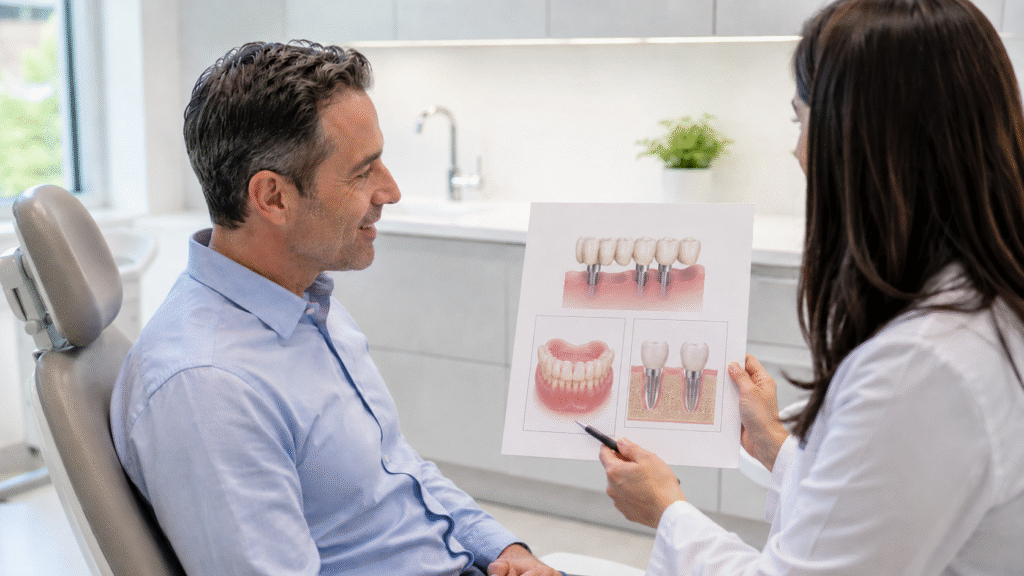
Dental implants, bridges, and dentures can all replace missing teeth, but the best tooth replacement option depends on the number of missing teeth, oral health, stability needs, timeline, and budget.
| Option | Fixed or Removable | Best For | Main Advantage | Main Consideration |
|---|---|---|---|---|
| Dental implant | Fixed or implant-supported | One tooth, several teeth, or full arch | Strong support and root replacement | Requires surgery, healing, and enough bone |
| Dental bridge | Fixed | One or a few missing teeth | Does not need to be removed | May require reshaping nearby teeth |
| Partial denture | Removable | Several missing teeth | Can replace multiple teeth with one appliance | May feel less stable than fixed options |
| Complete denture | Removable | Full-arch tooth loss | Replaces all teeth in an arch | May need adjustments as the mouth changes |
| Implant-supported denture | Removable or fixed, depending on design | Full-arch or multiple missing teeth | More stability than many traditional dentures | Requires implant placement and planning |
Short Answer: Which Option Is Best?
There is no universal “best” option. A dental implant may be best for one patient, a bridge may be better for another, and a denture may be the most practical option for someone else.
The most important question is not “Which treatment is best?” It is “Which treatment is best for my mouth, health, goals, and budget?”
Which Tooth Replacement Option Feels Most Stable?
Dental implants and implant-supported restorations often feel more stable than removable dentures because they are anchored to the jawbone. A bridge can also feel stable because it is cemented in place, but it is supported by neighboring teeth rather than a replacement root.
Traditional dentures can restore appearance and function, but they may move more than fixed options. Some patients adjust well to dentures, while others prefer implant-supported stability.
In general:
- Dental implants are often stable once healed
- Bridges are fixed and can feel secure
- Traditional dentures are removable
- Implant-supported dentures may feel more stable than traditional dentures
Cleveland Clinic notes that implant-supported dentures attach to implants in the jaw and can offer more stability than traditional dentures.
The right choice depends on whether the patient has enough bone, whether surgery is appropriate, and whether the patient wants a fixed or removable option.
Which Option Is Best for One Missing Tooth?
For one missing tooth, the most common options are a single dental implant or a dental bridge. A removable partial denture may also be considered in some cases, but many patients compare implants and bridges first.
Single Dental Implant for One Missing Tooth
A single implant can replace the missing tooth root and support one crown. It may be a good option when the neighboring teeth are healthy and there is enough bone support.
Possible advantages:
- Does not usually require reshaping neighboring teeth
- Replaces the missing tooth root
- Supports a custom crown
- Can be cleaned like an individual tooth, depending on design
- May help preserve bone in the missing tooth area
Possible considerations:
- Requires surgery
- Requires healing time
- May need bone grafting
- May cost more upfront than a bridge
- May not be suitable for every patient
Dental Bridge for One Missing Tooth
A bridge may be a good option when the teeth on each side of the gap already need crowns or when an implant is not recommended.
Possible advantages:
- Fixed in place
- May be completed faster than an implant in some cases
- Does not require implant surgery
- Can restore the visible gap and chewing function
Possible considerations:
- Neighboring teeth may need to be reshaped
- Cleaning under the bridge requires special tools
- The supporting teeth remain important to the success of the bridge
- It does not replace the missing tooth root
Which Is Better for One Tooth?
A dental implant may be preferred when the surrounding teeth are healthy and bone support is adequate. A bridge may be preferred when the nearby teeth need crowns anyway or when implant surgery is not appropriate.
The best option depends on your exam.
Which Option Is Best for Several Missing Teeth?
For several missing teeth, the options may include an implant-supported bridge, partial denture, or implant-supported denture. The right choice depends on how many teeth are missing and where they are located.
Implant-Supported Bridge
An implant-supported bridge may replace several missing teeth in a row without relying on natural teeth for support. Instead, implants support the bridge.
This may be considered when:
- Several adjacent teeth are missing
- The patient wants a fixed option
- There is enough bone support
- The patient is comfortable with implant treatment
- The dentist recommends it after evaluation
Partial Denture
A partial denture is removable and can replace several missing teeth in different areas of the mouth. It may be a practical choice when many teeth are missing or when implants are not preferred.
This may be considered when:
- Several teeth are missing
- The patient wants a removable option
- Surgery is not recommended
- A lower upfront cost is a priority
- The patient needs a broader replacement solution
Implant-Supported Denture
An implant-supported denture may be used when several or all teeth are missing. It can offer more support than a traditional removable denture.
This may be considered when:
- A traditional denture feels loose
- The patient wants more stability
- The jawbone can support implants
- The dentist recommends implant support
Q Smiles Dentistry offers dental services in North Miami Beach for patients who need restorative care, routine exams, and tooth replacement planning.
Which Option Is Best for Full-Arch Tooth Loss?
For full-arch tooth loss, the main options are complete dentures, implant-supported dentures, or full-arch implant solutions such as All-on-X. The right choice depends on oral health, bone support, budget, expectations, and whether the patient wants a removable or more fixed solution.
Complete Dentures
Complete dentures replace all teeth in the upper or lower arch. They are removable and can restore the appearance of a full smile.
They may be considered when:
- All teeth in an arch are missing
- Remaining teeth need removal
- The patient wants a non-implant option
- Surgery is not recommended
- The patient wants a more traditional solution
Implant-Supported Dentures
Implant-supported dentures attach to dental implants. Depending on the design, they may be removable by the patient or fixed by the dentist.
They may be considered when:
- Traditional dentures feel unstable
- The patient wants improved support
- There is enough bone for implants
- The patient is a candidate for surgery
All-on-X
All-on-X is a full-arch implant solution where a planned number of implants support a full set of replacement teeth. The “X” refers to the number of implants, which depends on the patient’s case and the dentist’s treatment plan.
It may be considered when:
- Most or all teeth in an arch are missing
- Remaining teeth cannot be predictably restored
- The patient wants a full-arch implant-supported option
- The patient has enough bone or can be evaluated for grafting
- The dentist determines it is appropriate
All-on-X and implant-supported dentures are listed among Q Smiles Dentistry’s dental implants and oral surgery services.
Cost Considerations in South Florida
Tooth replacement costs in South Florida vary because implants, bridges, and dentures involve different materials, timelines, procedures, and levels of complexity. Q Smiles Dentistry does not use one universal price for every patient because the final cost depends on the exam and treatment plan.
Factors that may affect cost include:
- Number of missing teeth
- Type of replacement option
- Materials used
- Need for extractions
- Need for bone grafting
- Need for PRF therapy
- Gum health
- Bone support
- Complexity of the bite
- Imaging and planning needs
- Lab work
- Insurance benefits
- Financing options
A traditional denture may have a lower upfront cost than a full-arch implant solution. A bridge may cost less upfront than a single implant in some cases, but it may involve the supporting teeth. A dental implant may require more treatment stages and healing time.
The best way to understand your real cost is to schedule a consultation. A dentist can examine your mouth, explain your options, and provide a treatment plan based on your specific needs.
Q Smiles Dentistry’s website notes that the office offers flexible financing options and welcomes patients to contact the office for details.
How to Choose the Right Tooth Replacement Option
Choosing the right tooth replacement option starts with an exam, not a guess. The same missing tooth problem can have different solutions depending on the patient.

Your dentist may consider:
- How many teeth are missing
- Which teeth are missing
- Whether nearby teeth are healthy
- Whether you have gum disease
- Whether you have enough jawbone
- Whether you grind your teeth
- Whether you smoke or vape
- Your medical history
- Your comfort with surgery
- Your budget and insurance benefits
- Your preference for fixed or removable teeth
- Your long-term maintenance goals
Choose Dental Implants If…
Dental implants may be worth discussing if you want a stable option, have adequate bone support, and are comfortable with a surgical treatment plan.
They may be especially relevant if:
- One tooth is missing
- Nearby teeth are healthy
- You want to avoid a removable appliance
- You want an implant-supported denture
- You want to compare full-arch implant options
- Your dentist says your bone and gum health are suitable
Choose a Dental Bridge If…
A bridge may be worth discussing if you are missing one or a few teeth and want a fixed option without implant surgery.
It may be especially relevant if:
- The neighboring teeth already need crowns
- You are not a candidate for implant surgery
- You want a fixed restoration
- The missing teeth are in a bridge-friendly area
- Your dentist determines the support teeth are strong enough
Choose Dentures If…
Dentures may be worth discussing if you are missing several teeth or a full arch and want a removable option.
They may be especially relevant if:
- You need to replace many teeth
- You want to avoid surgery
- You need a broader replacement option
- You want a more traditional removable solution
- You may consider implant support later
The Most Important Question to Ask
Ask your dentist: “Which option gives me the best balance of function, comfort, maintenance, cost, and long-term oral health for my specific mouth?”
That question is more useful than asking which option is generally best.
Why Choose Q Smiles Dentistry in North Miami Beach?
Q Smiles Dentistry is a dental clinic located at 68 NE 167th St B, Miami, FL 33162, serving North Miami Beach, Golden Glades, North Miami, Aventura, Sunny Isles Beach, Miami Gardens, and nearby Miami communities. The clinic provides dental implants, restorative dentistry, family dentistry, emergency care, cosmetic dentistry, and other dental services.
The Q Smiles Dentistry website describes the clinic as a modern dental office with personal attention and bilingual support for the North Miami Beach community.
Patients considering tooth replacement can benefit from local care because treatment may involve exams, imaging, planning, procedures, follow-up visits, adjustments, and maintenance. Having a dental office nearby can make the process more convenient.
Q Smiles Dentistry’s contact page lists the office phone number as (305) 947-6453 and the address as 68 NE 167th St B, Miami, FL 33162.
CTA: Compare Your Options With a Dentist
If you are comparing implants, bridges, and dentures, the next step is a personalized dental evaluation. Q Smiles Dentistry can help you understand what is realistic for your mouth, your goals, and your budget.
Call +1 305-947-6453 or visit Q Smiles Dentistry at 68 NE 167th St B, Miami, FL 33162 to request an appointment.
FAQs About Tooth Replacement
1. What is the best tooth replacement option?
The best tooth replacement option depends on your dental exam. Dental implants, bridges, and dentures can all work well for different patients. Your dentist needs to evaluate your gums, jawbone, bite, health history, number of missing teeth, and treatment goals before recommending the right option.
2. Is a dental implant better than a bridge?
A dental implant may be better for some patients because it replaces the missing tooth root and does not usually require reshaping neighboring teeth. A bridge may be better for other patients, especially when nearby teeth already need crowns or implant surgery is not recommended. The right option depends on your case.
3. Are dentures still a good option for missing teeth?
Yes, dentures can still be a helpful tooth replacement option, especially for patients missing many teeth or a full arch. Some patients choose traditional removable dentures, while others may be candidates for implant-supported dentures.
4. Can I replace one missing tooth without an implant?
Yes. A dental bridge or removable partial denture may be considered for one missing tooth. However, each option has different advantages and limitations. Your dentist can explain which one fits your oral health and goals.
5. Do bridges last as long as implants?
Longevity varies by patient, material, oral hygiene, bite force, and maintenance. Implants and bridges can both last many years, but neither should be described as guaranteed. Regular dental visits and good home care are important for both.
6. What is the most affordable tooth replacement option?
Traditional removable dentures often have a lower upfront cost than implants, but cost depends on the case. Bridges, implants, dentures, extractions, grafting, materials, and lab work can all affect the final fee. An exam is needed for an accurate estimate.
7. Can missing teeth cause other dental problems?
Missing teeth can contribute to shifting teeth, bite changes, chewing difficulty, speech changes, and bone changes in the missing tooth area. The ADA notes that replacing missing teeth can benefit appearance and health, and missing teeth can affect eating and speaking.
8. Where can I compare tooth replacement options near North Miami Beach?
You can compare tooth replacement options at Q Smiles Dentistry, located at 68 NE 167th St B, Miami, FL 33162. The clinic serves North Miami Beach, Golden Glades, North Miami, Aventura, Sunny Isles Beach, Miami Gardens, and nearby Miami communities.
Conclusion: The Best Tooth Replacement Option Starts With the Right Evaluation
Dental implants, bridges, and dentures can all help replace missing teeth, but they are not interchangeable. Each option has a different structure, timeline, maintenance routine, cost range, and level of stability.
A dental implant may be a strong option for patients who want root replacement and have enough bone support. A bridge may work well when a fixed option is needed and the neighboring teeth can support it. A denture may be practical for patients who need to replace several teeth or a full arch with a removable appliance. Implant-supported dentures and All-on-X may also be considered for patients who want more support than traditional dentures.
The right tooth replacement choice depends on your exam, your health, your bite, your goals, and your dentist’s recommendation.
If you are in North Miami Beach, Golden Glades, North Miami, Aventura, Sunny Isles Beach, Miami Gardens, or a nearby Miami community, Q Smiles Dentistry can help you compare your options clearly.
Call +1 305-947-6453 or schedule a visit with Q Smiles Dentistry in North Miami Beach.